September is National Suicide Prevention Awareness Month

September is National Suicide Prevention Awareness Month. This month can provide an opportunity to discuss the ongoing mental health crisis, the alarming increase in work-related suicides, and what you can do to help.

In recent years, the Occupational Safety and Health Administration (OSHA) and the Federal Department of Labor have begun to emphasize the importance of addressing mental health in the workplace as key to reducing injury and illness rates among employees. OSHA has noted that recent studies conducted by the Centers for Disease Control and Prevention (CDC) have shown a concerning uptick in suicide rates among working age adults. It can be difficult to discuss mental health in the workplace, because that is a space where personal problems are typically left at the door. However, creating an environment at work where anyone can reach out for help when they are in crisis is necessary to prevent suicides and other long term mental health issues.

Resources

Suicide & Crisis Hotline- Call or Text 988

The National Institute for Occupational Safety and Health (NIOSH) published an educational study which asserts that stressful job conditions, in combination with individual and situational factors, contribute to a higher risk of injury or illness. Job-related stress can lead to poor health and even injury for workers. Reducing job-related stress from the workplace is important in ensuring that everyone has access to a safe and healthy work environment. 

The CDC states that the workplace can contain several factors which have been shown to contribute to higher suicide risks among workers.

The reduction of these factors may lead to better mental health outcomes for employees:

  • Access to lethal means (e.g. the ability to obtain things such as firearms and medications)
  • Long working hours
  • Low job security, low pay, and job stress
  • Workplace bullying

The effects of suicide can impact individuals in any industry or occupation. There are trends though that show a higher prevalence of suicide in some occupations more than others. 
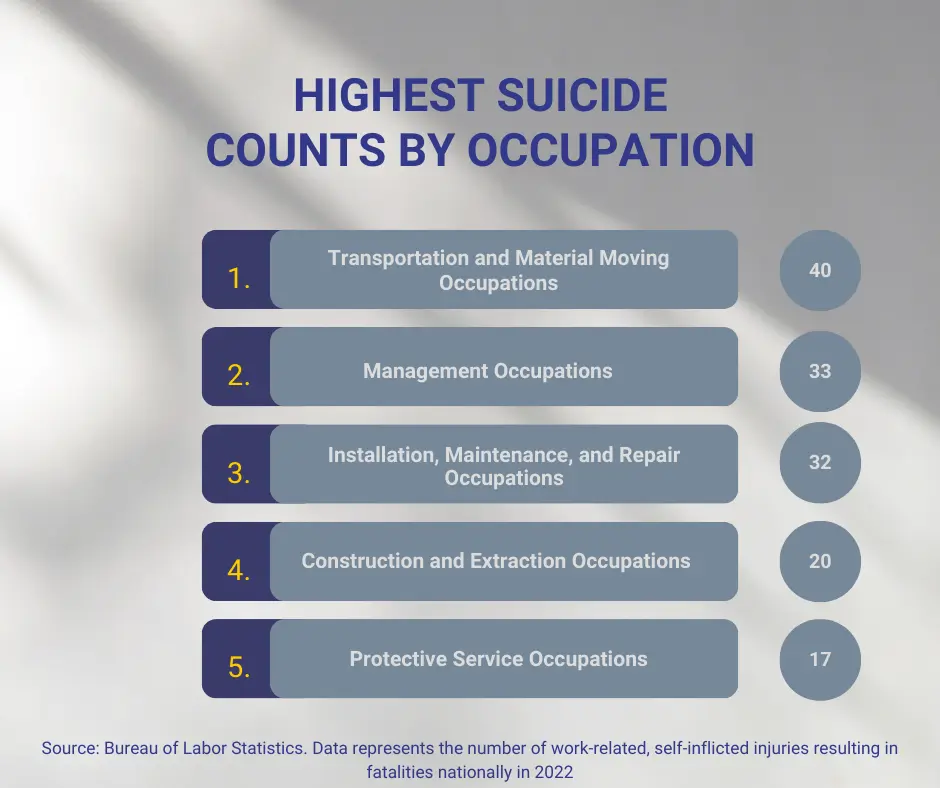
These occupations demonstrated the top five highest counts of work-related suicide during the reference year 2023. Transportation and Material Moving workers had the highest count of work-related suicide nationally in 2023. According to the Bureau of Labor Statistics, in the Commonwealth of Virginia, Transportation and Material movers made up over 300,000 of the state’s workers as of 2024.

This month, we aim to honor those who lost their lives and encourage further education and awareness concerning mental health in the workplace. It’s important to know that resources are available for individuals who are struggling as well as for those who want to learn more about how they can support their colleagues.

The Virginia Department of Labor and Industry’s What If? Campaign challenges employers and employees to ask the question: What if you could go your whole career injury free? Mental health struggles are just as critical to preventing career-ending harm as avoiding physical hazards. We encourage your team to start a conversation this Suicide Prevention Awareness Month:

  • Host a Safety Includes Mental Health toolbox talk. 
  • Share the 988 Crisis Lifeline number in breakrooms, newsletters, paystubs, and safety meetings. 
  • Encourage peer support programs or employee resource groups. 

Caring for one another is essential to workplace safety. Visit https://doli.virginia.gov/what-if/ to learn more.

Additional Resources

2025 Suicide Prevention Awareness Month Toolkit

Substance Abuse and Mental Health Services Administration (SAMHSA) toolkit with resources and information.

Role of Employers in Preventing Suicides

OSHA graphic displaying ways in which employers can engage in suicide prevention in the workplace.

NIOSH STRESS…At Work Publication

A publication by NIOSH highlighting the effects of job stress on the worker and how it can lead to adverse health and work outcomes.

CDC Suicide and Occupation

CDC statistics and resources for suicide prevention in the workplace.

American Foundation for Suicide Prevention

Provides resources and aid to those affected by suicide, including Risk Factors and Warning Signs

The Center for Construction Research and Training (CPWR) – Opioid Resources

Provides resources to help prevent opioid deaths in construction.

Construction Industry Alliance for Suicide Prevention (CIASP)

Provides resources, articles, and websites.

Construction Working Minds

Provides resources on how to address workplace suicide for workers, managers, and industry associations.

Suicide in the Construction Industry: Breaking the Stigma and Silence: American Society of Safety Professionals

Provides recommendations on how to start a conversation in the industry, and three keys for providing help

U.S. Department of Veterans Affairs – Suicide Prevention

Provides resources for veterans and their loved ones, friends, and health care providers.
Exposure to heat is a serious occupational hazard, affecting both indoor and outdoor workers. Without proper training and protective measures, it can lead to severe—and sometimes fatal—illnesses. The good news: heat-related illnesses are preventable. Understanding the risks and solutions can make all the difference in safeguarding employees from harm. Learn how to protect your workforce.  Working in Outdoor and Indoor Heat Environments

The University of Virginia’s Weldon Cooper Center for Public Service conducted a study to evaluate the economic effects of the VOSH compliance programs on workplace safety, health, and economic growth.

The study concluded that the VOSH compliance programs provide substantial economic benefits to the state of Virginia by reducing workplace injuries and illnesses, improving worker productivity, and generating positive fiscal impacts. The cost-effectiveness of VOSH inspections further supports the value of continued investment in workplace safety and health initiatives.

For more information and to view the study in its entirety, please visit: https://doli.virginia.gov/economic-impact-of-vosh/

DOLI’s Division of Labor and Employment Law is hosting virtual Youth Employment Compliance Training Sessions for Restaurants. The sessions will be held on June 12, 2025 and June 26, 2025 at 11 AM & 2 PM.

Join us to learn best practices for employing 14 and 15 year old employees in restaurant occupations. Topics of discussion include youth employment certificates, hours restrictions, permissible/prohibited/hazardous duties, and a Q&A with DOLI’s child labor law experts.

Registration is free and required. Register online at: bit.ly/43H6jP5.

Event Flyer

Effective July 1, 2025, legislation passed by the General Assembly during the 2025 session will go into effect.

Work-Study Programs for Children Aged Sixteen Years or Older

House Bill 1667/Senate Bill 1228 further allows children aged 16 years or older to work in barbershops or cosmetology salons under certain circumstances.

Under § 40.1-100 Code of Virginia, certain employment for youth employees is prohibited or limited. Included in these limitations is the prohibition of any child under eighteen years of age from performing work “in any capacity in preparing any composition in which dangerous or poisonous chemicals are used.” This law allows children aged 16 years or older, employed under a valid work-training program or holding a cosmetology or barber license from the Board for Barbers and Cosmetology, to work in barbershops or cosmetology salons. These exemptions further expand an initial exemption enacted in 2023 which allows for children aged 16 years or older to work in barbershops or cosmetology salons as part of a registered apprenticeship program.

Information about regulation and licensure under the Board for Barbers and Cosmetology can be obtained by contacting the Board Office at (804) 367-8590.

Protections for Children Engaged in Content Creation

House Bill 2401/Senate Bill 998 creates specific protections for children under 16 years of age who are engaged in the work of content creation.

This legislation amends Code of Virginia  §§ 40.1-2, 40.1-79.01, and 40.1-80.1 and establishes Code of Virginia §§ 40.1-109.1 and 109.2. Under the law, content creators whose content regularly involves a child, or their likeness, must maintain records related to the child’s appearance in the content and the compensation generated from it. A percentage of gross earnings on any content involving a qualifying child must also be set aside into a trust account accessible to that child once they reach 18 years of age. Children involved in content creation are also prohibited from being exposed to any hazards capable of causing serious harm or using any hazardous equipment, and must be under the direct supervision of an adult who ensures compliance with all applicable safety requirements.

Expansion of Prohibition of Non-Compete Agreements for Low Wage Workers

Senate Bill 1218 expands Virginia’s laws on covenants not to compete by amending Code of Virginia § 40.1-28.7:8.

Under Code of Virginia § 40.1-28.7:8, an employer may not enter into, enforce, or threaten to enforce a covenant not to compete with any low-wage employee, defined as an employee whose average weekly earnings are less than the average weekly wage of the Commonwealth or an independent contractor whose hourly rate is less than the median hourly wage for the Commonwealth as reported by the Bureau of Labor Statistics.

This law further expands the definition of “low-wage employee” to include any employee who, regardless of average weekly earnings, is entitled to overtime compensation under the provisions of 29 U.S.C. § 207, i.e., the Fair Labor Standards Act. This expanded coverage does not apply to contracts, covenants, or agreements entered into prior to July 1, 2025.

As this law extends noncompete prohibitions to a new category of workers, DOLI strongly encourages employers who use noncompete agreements to review the updated statute and ensure that all covenants they enter into on or after July 1, 2025, are compliant with the law. Information about overtime coverage and exemptions can be obtained by contacting the United States Department of Labor Wage and Hour Division at (866) 487-9243 or by visiting https://www.dol.gov/agencies/whd

About the Agency:

It is the mission of the Virginia Department of Labor and Industry (DOLI) to make Virginia a better place in which to live, work, and conduct business. DOLI’s Labor and Employment Law Division administers and enforces the laws of the Commonwealth that govern employee pay, the employment of children, and certain other statutes that relate to the workplace. Additional information about coverage and requirements under the new legislation can be obtained by contacting the Division at laborlaw@doli.virginia.gov.

Join the Virginia Department of Labor and Industry’s VOSH program at our annual conference featuring over 30 engaging educational sessions, innovative exhibitors, and endless opportunities to connect with top Safety and Health professionals. An injury-free career culture prioritizes employee safety and well-being, aiming to prevent incidents and injuries, rather than just reacting to them, by fostering a proactive collaborative approach to safety. Join other Safety and Health professionals and learn how you can inspire injury-free careers in your organization.

The 2025 VOSH Safety and Health Conference will be held from July 16-18, 2025, at The Hotel Roanoke (110 Shenandoah Ave NE, Roanoke, VA 24016). To learn more about the upcoming conference, please visit:https://doli.virginia.gov/voshconference/.

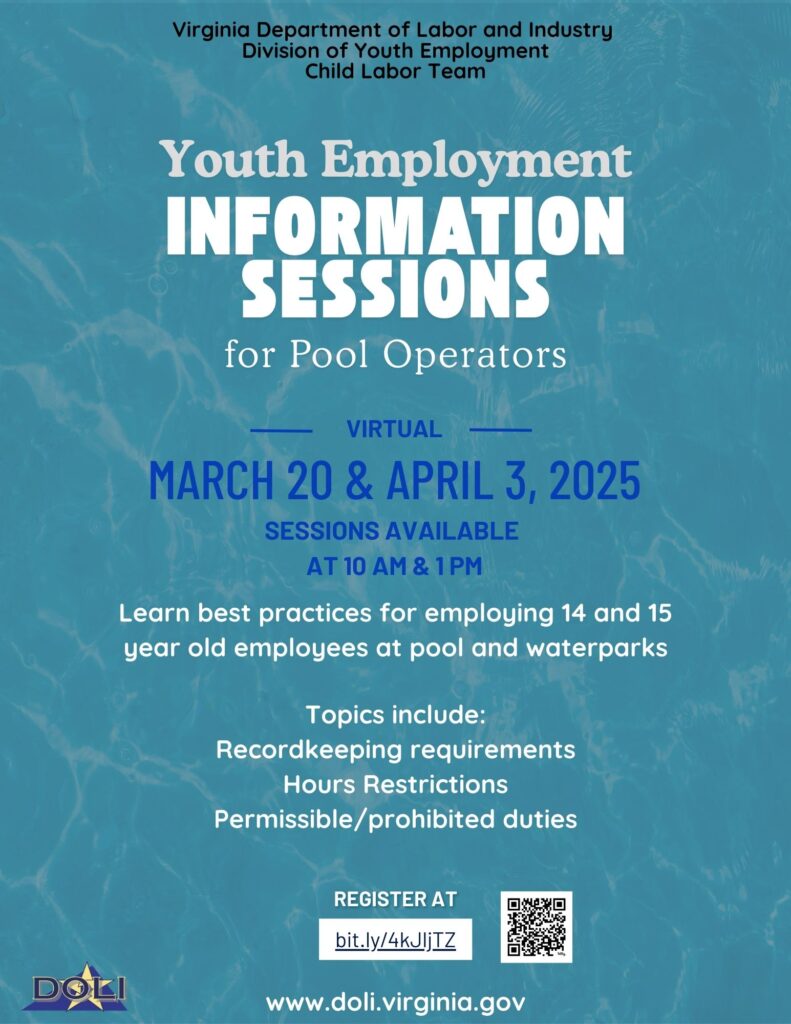
DOLI’s Division of Labor and Employment Law is hosting virtual Youth Employment Information Sessions for Pool Operators. The sessions will be held on March 20, 2025 and April 3, 2025 at 10 AM & 1 PM.

Join us to learn best practices for employing 14 and 15 year old employees at pools and waterparks. Topics of discussion include recordkeeping requirements, hours restrictions, permissible/prohibited duties, and Q&A with DOLI’s child labor law experts.

Registration is free and required. Register online at: bit.ly/4kJljTZ.

The Safety and Health Codes Board will hold a public meeting on March 19, 2025 at 10:30 AM at Libbie Mill Public Library (2100 Libbie Lake E Street, Richmond, VA 23230).

For more information, please visit: https://www.townhall.virginia.gov/L/ViewMeeting.cfm?MeetingID=41419


We are excited to announce the 2025 Virginia Trench Safety Summit, scheduled for April 22, 2025, at the Virginia Public Safety Training Center (7093 Broad Neck Road, Hanover, VA 23069).

The Virginia Department of Labor and Industry, under the VOSH Institute for Learning & Outreach (VILO), along with the Virginia Department of Fire Programs and the North American Excavation Shoring Association (NAXSA) are collaborating to provide state-of-the-art excavation and trench safety training and demonstrations to workers and contractors this spring. The Virginia Trench Safety Summit 2025 will kick off with keynote speaker Eric Giguere, sharing his dynamic story of survival after being buried alive in a trench collapse.  He shares his experience and perspective in a powerful and compelling story, highlighting key elements of trench safety and rescue. Virginia Occupational Safety and Health (VOSH) staff will provide information on OSHA standard and key updates on trench safety best practices and compliance. The outdoor afternoon sessions include 3 live trench side demonstrations led by industry and safety experts.  Demonstrations include hydraulic shoring, proper setting and use of aluminum and steel trench boxes, and a live trench rescue demonstration by the Virginia Department of Fire Programs in partnership with the Henrico County Division of Fire.

 Registration is required for this free event, which includes breakfast and lunch. To learn more, please visit: https://www.naxsa.org/page/2025-virginia-trench-safety-summit

This event is key in DOLI VOSH’s mission to promote safe workplaces and employ best practices by creating a culture of Injury Free Careers (What IF?) in the Commonwealth.  VILO supports that mission as Virginia’s Center for Excellence in the development of injury and illness free career culture. NAXSA is an OSHA Alliance Program Partner for Safe Trenching and Excavation Operations.

Due to recent winter weather, the City of Richmond and related counties in the Richmond Metro area encountered disruptions in their water supply. This event impacted water provisions and resulted in advisories.  Official updates indicate that the City and local counties are working to abate the situation and we understand some water flow has been restored. During this temporary situation, it is important to be mindful of VOSH requirements related to water and sanitization.

The Department of Labor and Industry requires that employers provide potable water in the workplace for drinking, washing, and other personal needs. The water must be readily accessible, and employers cannot require employees to pay for it. 1910.141(b)(1)(i) requires that potable water shall be provided in all places of employment, for drinking, washing of the person, cooking, washing of foods, washing of cooking or eating utensils, washing of food preparation or processing premises, and bathrooms. This applies to the construction industry as well, per 16VAC25-160-10, the construction industry sanitation standard.

Here are some other requirements for drinking water in the workplace:

  • Water dispensers: Dispensers must be designed to maintain sanitary conditions, be closable, and have a tap. Water shall not be dipped from containers. Any container used to distribute drinking water shall be clearly marked as to the nature of its contents
  • Containers: Open containers like barrels, pails, or tanks are prohibited.
  • Drinking cups: Shared drinking cups are prohibited. The water shall be dispensed in single use drinking cups or personal bottles or containers. The use of the common drinking cup is prohibited.
  • Temperature: Water should be cool.
  • Quantity: There should be enough water to meet the needs of each employee.
  • Refilling: Drinking water containers should be refilled daily or more often as needed.
  • Cleaning: Drinking water containers should be regularly cleaned and kept covered.